
OVERVIEW - From FEB 19-22, I attended Presscheck Consulting No Fail Pistol and Rifle classes in Marana, AZ. The class was hosted by Ash Hess from VLTOR at the newly purchased VLTOR shooting complex (formerly the Marana Gun Club). This was an open enrollment class with a mix of LE and civilians. We had a couple of the (newly relaunched) Surefire Institute staff, an instructor from TNVC, and a staff instructor from Thunder Ranch on the line. Weather for the classes was coolish in the morning and warmish in the afternoon with some light rain a couple of mornings. The desert in the winter is gonna be the desert in the winter.
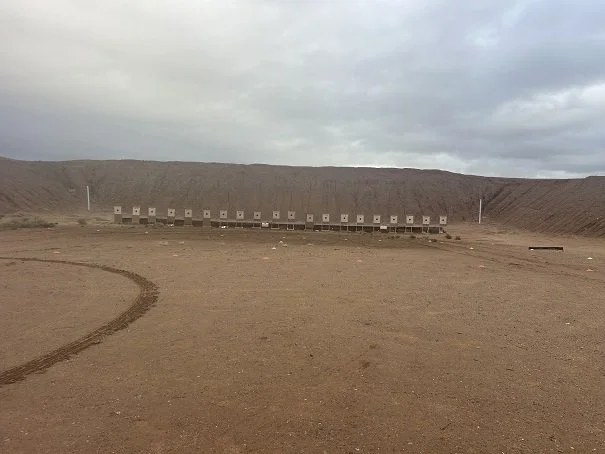
One of the pistol bays at the VLTOR Shooting Complex
The instruction for the classes was provided by SGM(R) Chuck Pressburg, a retired SOF operator with extensive experience deploying during the GWOT. SGM(R) Pressburg taught the classes using vignettes (Marines, click here) from his time deploying or recent self-defense/OIS, tying a drill into the incident and then demonstrating the drill and talking about what was expected. The philosophy of the class places a heavy emphasis on accountability for every round fired.
GEAR - I wore the same belt kit that I wear teaching (very similar to what I wore doing overt stuff when I was deploying). Ronin tactics belt, BFG magazine pouches, First Spear med kit, JM Custom Kydex holster. I didn’t wear any armor or chest rig during either class.
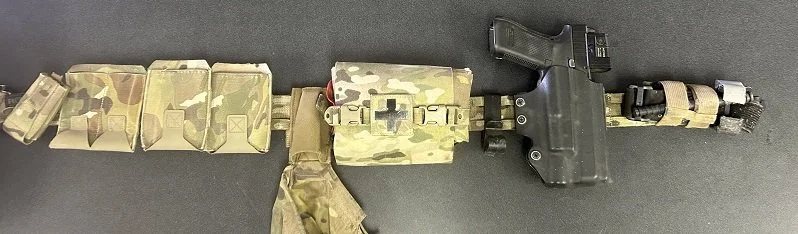
Belt kit worn in classes
GUNS – For the pistol class, I used my Gen 5 G45MOS with ACRO2. In the rifle class I used a Sionics 10.5in AR. The rifle had an Aimpoint T2 mounted on a Unity FAST mount, and BFG Sling. I pulled a 3x magnifier out of the safe but left it sitting on my desk… so 1x was what I had. Both guns ran without issue.
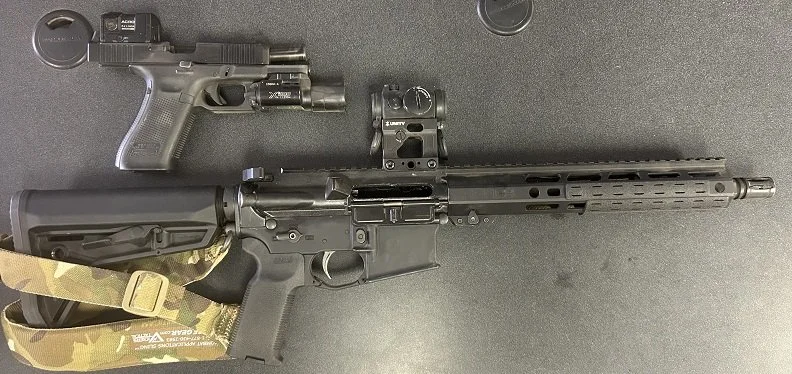
G45 and Sionics SBR
The round count for the classes was approximately 1000rds each for pistol and rifle.
PISTOL POI –
As mentioned, the pistol POI is heavily weighted towards accountability for every shot fired. Most of the class was shot on the B8 bullseye from 25yds into 10yds. The B8 provides a metric for accuracy that is much finer than something like an A-zone. Drills were divided between slow/slower drills fired for score, and faster courses of fire, with the designated hit area being the entire black area of the bull (5.5in diameter). Slow fire strings were briefed as 10 individual events rather than shooting one, 10rd string. We were firing ten strings of single shots with the goal of getting the best possible shot out of ourselves and the gun each time.
We shot some pairs, 1-5, and triple 5s (5 shots from the holster from 15yds with a par time of 5sec). We worked through that freestyle, SHO, and WHO. The pace of the class and the yard lines used were dictated by student performance.
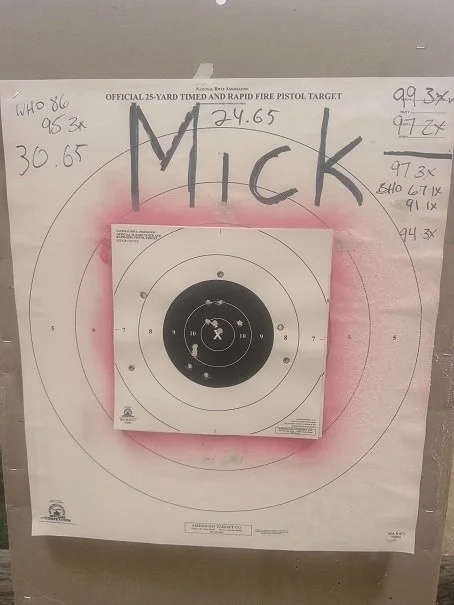
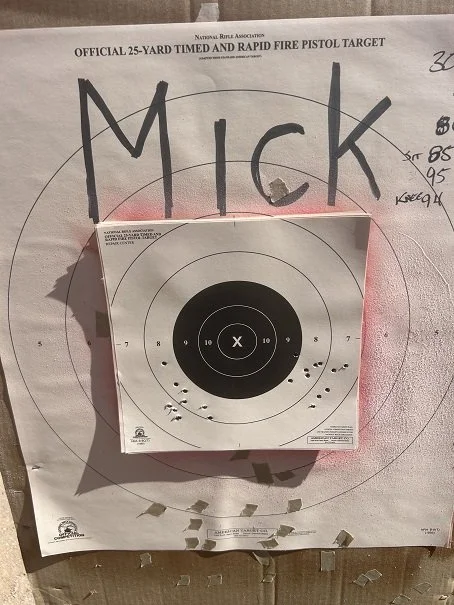
No fail pistol target after the Presscheck Rundown
You can see my 25yd Freestyle scores in the top right of the target, 25yd SHO scores below those and 25yd WHO scores top left. The score from the Presscheck Rundown is shown with the raw time at the top. Adjust time after penalties on the left side (30.65).
I had some significant issues with right shoulder stability during my first attempt at 25yd SHO slow fire (score of 67 1x). I was really frustrated with my performance because the evidence that what I was doing wasn’t working was clear as day in the optic. My wobble covered the entire 6-ring and I couldn’t stabilize it doing what I was doing… but I kept pulling the trigger anyway. I hung my head in shame after we scored that COF. I had to change several things about the way I shot it to clean that up on the second attempt
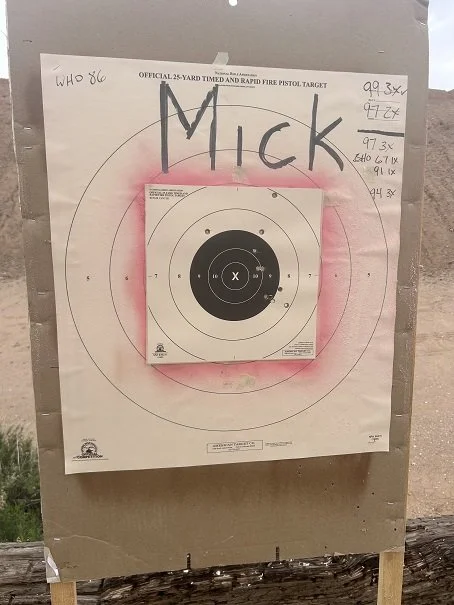
WHO slow fire target. Note clear inboard wrist break
My first attempt at WHO showed a very clear inboard wrist break (score of 86, in the top left of the target). Putting the proof on paper like that made me very aware of it and I was able to clean it up on my second attempt.
WHO run at triple 5s
The second half of T-day 2 we got onto steel and shot wide target-to-target transitions on steel. Most of the steel was placed around 25yds with some pieces out around 40. This required guys to still respect their sights and trigger rather than just banging away as soon as they saw red over white.
PRESSCHECK RUNDOWN
COF – 25yd draw and fire five rounds freestyle.
Run to the 15yd line while executing a reload.
15yds fire five rounds SHO.
Run to the 10yd line while executing a reload.
10yds fire five rounds WHO.
Score is time plus penalties.
8-ring = 1sec
7-ring = 2sec
6-ring = 3sec
5-ring = 5sec
Outside the 5-ring = 10sec
My score after the 6sec worth of penalties that I ate was 30.65
PISTOL LESSONS LEARNED –
Let your sights be your guide. – At closer distances, I’ll shoot SHO in the exact same body position that I shoot freestyle. I just take my support hand off the gun. This works for me most of the time so that’s what I was doing shooting slow fire at 25… It didn’t work very well. I could see it wasn’t working well through the optic and instead of changing, I pressed on. When we reshot the SHO slow fire I changed body position (strong side foot forward, elbow dropped and pointing at the ground) and that improved my wobble significantly. I should have made *a* change as soon as I got the gun on target, but I’m pigheaded and usually need to fail spectacularly before I learn. If the sights don’t show you what you need to see, you have no business pulling the trigger.
Shoot like a professional, not a petulant child – I ended up with no score when we “tested” on triple fives because I dropped a round into the white on each of my three attempts. I know I can shoot that COF in around 4 seconds. I’ve done it dozens of times. So even after I had UNQ’d on my first two attempts, I kept shooting the same pace. Low and behold, I dropped a round on the last one too.
Instead of slowing down a fraction of a second and putting the rounds where they needed to go, I shot the pace that I *wanted* to shoot and ended up without a qualifying run.
OVERALL – This was the second time I’ve attended this class. This is not a class about shooting at the edge of your speed threshold; it’s about maximum accountability for each round fired out of your pistol. It’s about staying out of your ego, reading your sights and applying the fundamentals on every shot. Chuck describes it as guided learning. If you are engaged during the class, you will definitely come away with improvements.
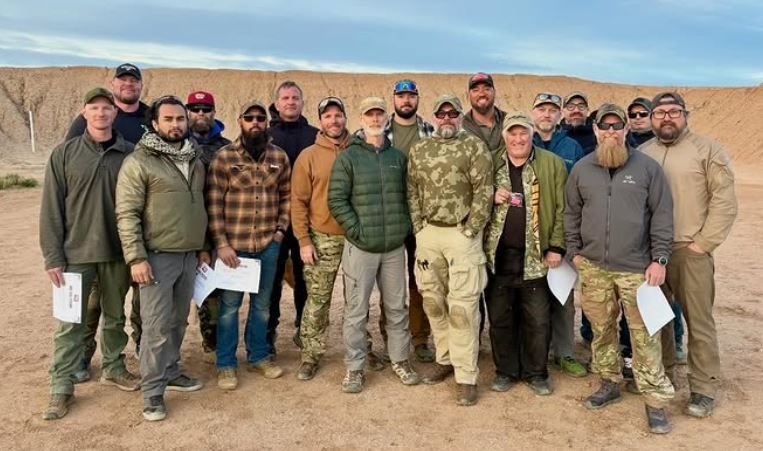
No Fail pistol class photo
RIFLE POI –
After the pistol class, the rifle class felt like a step down in intensity. We moved away from a high accountability philosophy to focusing on the skills Chuck found important in his career fighting with a rifle in the open. With that in mind, the first day was primarily focused on zeroing and gathering data on our rifles from 50yds out to 300yds. I stuck with a 200yd zero on my gun because I know the holds (except when I don’t…).
During the zeroing process, Chuck talked about the concept of quartering the target to figure out if you are centered up or not. If you look at my 50yd group below, it looks okay. When you quarter the target, you can see that it’s clearly to the right and low. Quantified, 8 out of 10 shots are right of the yellow vertical line. 7 out of 10 shots are below the orange horizontal line. Pretty good, but not perfect. I put a click or two on the optic after that group.
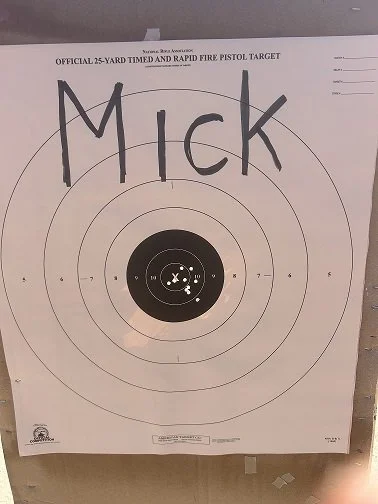
50yd shot group
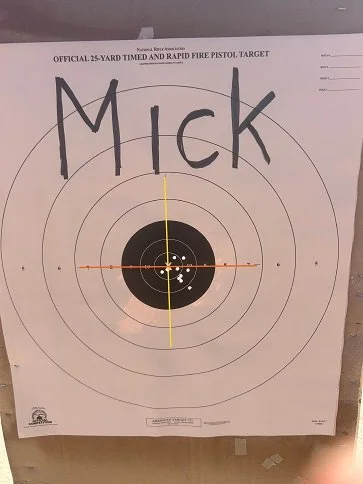
Quartering the target
We spent the morning slow firing 10rd strings from the prone and making any needed sight adjustments to get as perfect a zero as we could. We shot from the 50, the 100-, 200-, and 300-yard line and identified what we needed to hold at each yard line to hit the target. We did this by holding center of the bull at each yard line and noting where rounds impacted. I struggled holding a consistent point on the target at the 200 and 300yd lines with a 1x dot. I also had a hard time maintaining consistent head position on the rifle. As my neck would fatigue, my head would drop and I’d be looking through the optic from a different angle… but nobody cares about your gun problems.
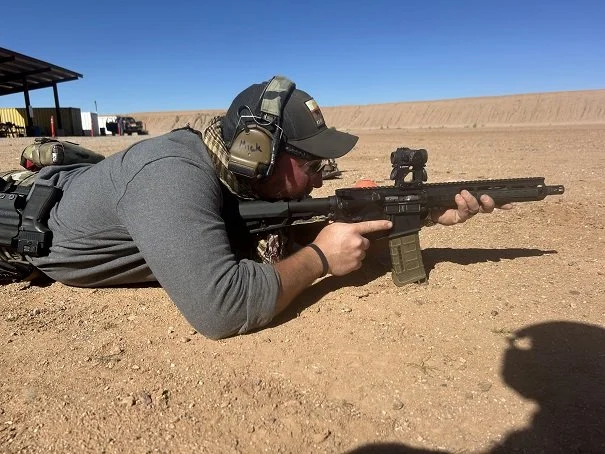
Chin weld... not optimal
While the class was collecting data, Chuck talked about how zeros are all theory until you get out and put them on paper with your gun/optic/ammo combination. Shooting your gun at 50 does *not* give you a 200yd zero. It gives you a 50 yd zero. Saying you have a 25/300 or a 50/200 is BS. If you put clicks on the gun at 200, you have a 200 yd zero. If you’ve only shot at 50, you have a 50yd zero. After that it’s on you to know where to hold at different distances.
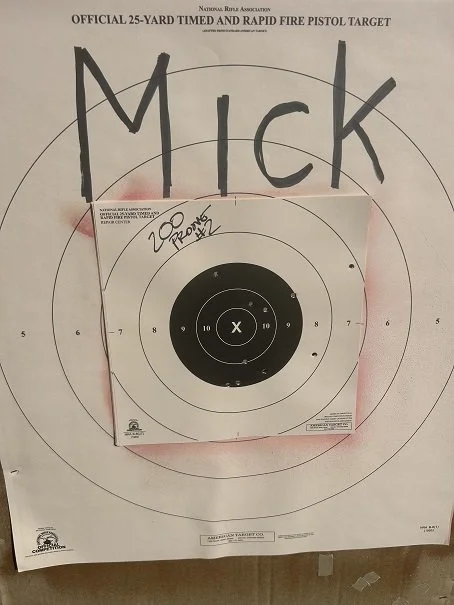
200yd shot group. There was a slight left-to-right wind, so I didn't adjust anything.
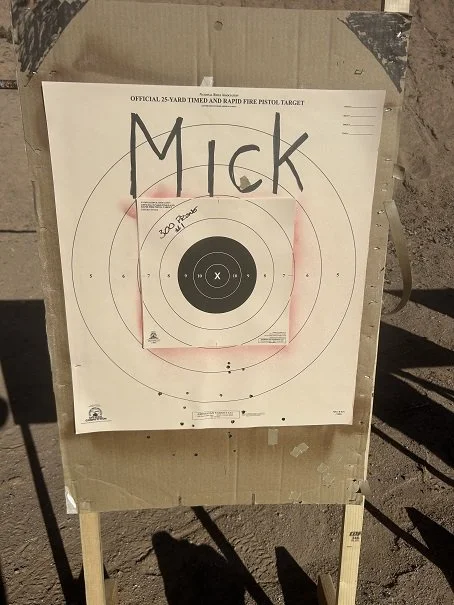
Two 10rd 300yd shot groups overlapped. This gives me about a 12in hold with that gun/optic/ammo combination
After data collection, we got on our feet and worked rapid presentations from 25yds in. We continued shooting on B8s but changed the hit are to the entire black without regard for the scoring rings. We worked on offset from 3 to 25 and shot a 30rd, 300pt “CQB aggregate”. This consists of 5rds each from the 25, 20, 15, 10, 5, and 3 (my score was 300 22x… thank God for line breaks).
T-Day 2 started with a cold 100pt aggregate from the prone at 100yds. I had a hell of a time holding a consistent sight picture low on the bull and gave up a bunch of points high as a result. We worked some intermediate positions (sitting and kneeling) from 75 and 50. We shot both positions for score twice to allow a couple of the shooters on the line to sort out some issues with their position. After positions, we went back to the 100yd line and fired with our rifles rotated 90 degrees to either side (groups shown in picture). Again, the emphasis was on knowing your holds to hit the target. Spoiler alert, hold high and in the direction of the magazine. Chuck explained the ballistics of this and got pretty technical*, but I was able to keep up.
*“uppy-ups become righty-rights or lefty-lefts when you hold the gun at 90*” - Chuck Pressburg
We shot several other drills in the afternoon working target to target transitions from near-to-far and far-to-near. These were done on a B8 at about 7 (rounds have to stay in the black) and a piece of steel offset right or left at 100. We wrapped the class up with shooting from alternate positions on/around barricade at some steel at 100yds. This was mostly a check on learning for a lot of the information that had been covered.
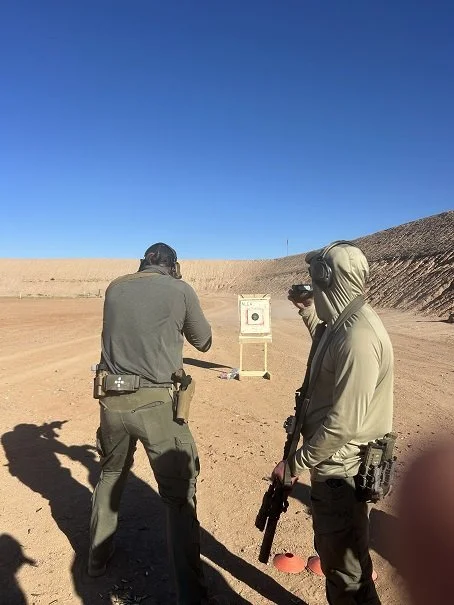
Surefire Instructor CJ working far to near target transitions
RIFLE LESSONS LEARNED –
The mission drives the gear – Shooting the Unity mount made getting a consistent cheek (chin?) weld tough when shooting from the prone and shooting a 1x optic at distance was asking a lot of my eyes. High mounts and 1x red dots are purpose built to shoot at closer ranges, standing on your feet. It’s not that you can’t make it work at distance or from the prone, you can. They are just sub-optimal for that purpose. Know what you’re doing (or likely to do) with the gun and set it up accordingly.
Show up at the class with quality ammo – This one wasn’t me (seriously). The guy next to me showed up at the class with steel cased ammo and had all the gun problems the first half of the first day. He had to borrow cleaning rods to knock stuck shell casings out of his gun every 5-10 shots until another student sold him a case of quality ammo.
If you’re going to take the time out of your life, and spend the tuition money on a class, don’t try to save $50/case on the ammo you bring. It’s going to limit your ability to learn and hold everyone else up while you get fixed. Don’t be that guy.
OVERALL – Like No Fail pistol, this class is not an “advanced” class. No cheeta flips or shoulder roles. Understanding the shot process and applying the basics is the name of the game. This class is about the basics performed at a high level, consistently. This class could be shot by someone with a brand-new carbine or someone who has been carrying a rifle for their entire life. They will get different things out of the class, but they would both get their money’s worth.